Publish in a journal
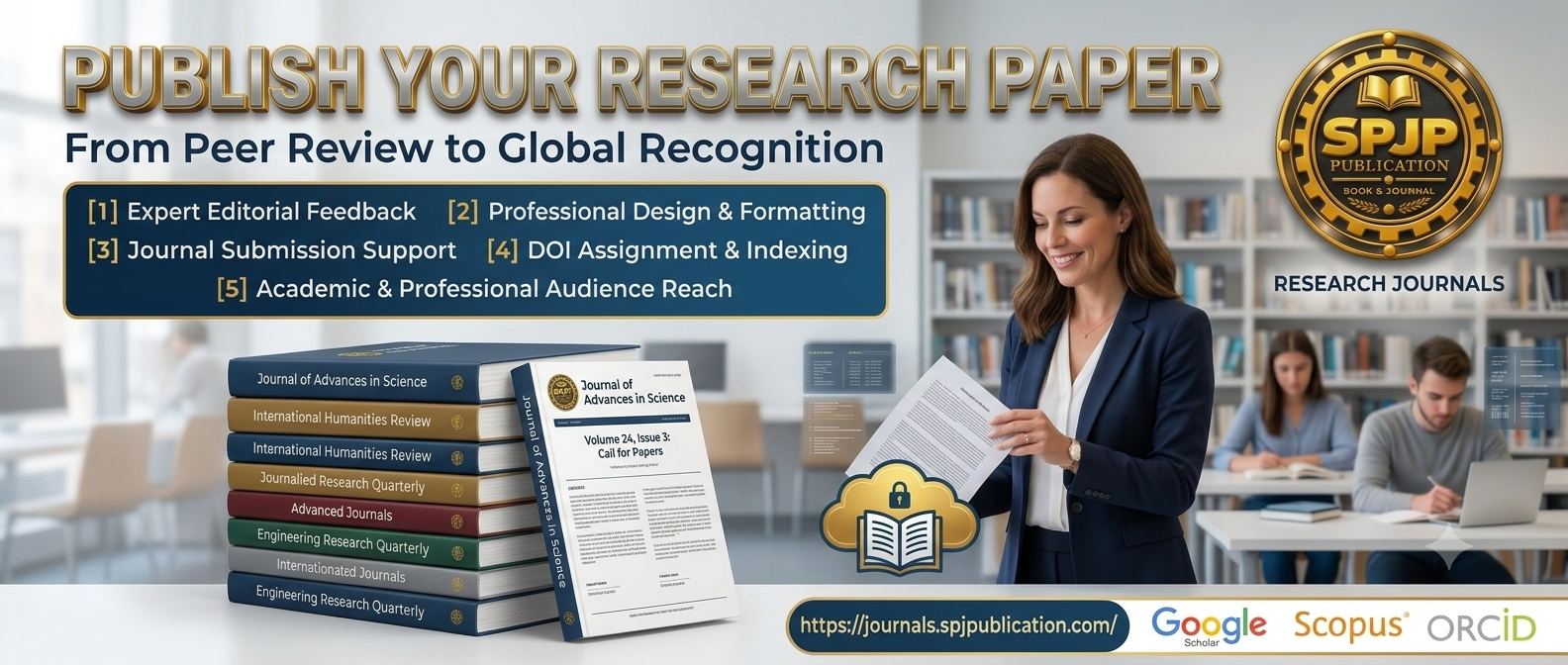
Step-by-Step Guide to Article Publishing: At SPJ Publications Pvt. Ltd., we aim to provide authors with a clear, transparent, ethical, and structured pathway from manuscript preparation to publication. Our publishing process is designed to maintain academic quality while providing authors with a professional and supportive publishing experience. Although individual journals may have specific requirements, the following steps represent the general publication workflow followed across SPJ Publications journals.
1. Select the Appropriate Journal: Before preparing your manuscript, identify the journal that best matches the subject, scope, and objectives of your research. Authors should carefully review the journal's, Aims and scope, Subject areas and research focus, Article types accepted, Author guidelines, Manuscript formatting requirements, Reference style, Peer-review policy, Publication ethics requirements, and Open-access and publication fee policies, and Copyright and licensing terms. Submitting your manuscript to an appropriate journal helps ensure that the research reaches the intended academic and professional audience. Authors should avoid submitting the same manuscript simultaneously to multiple journals.
2. Prepare Your Manuscript: Authors should prepare their manuscript in accordance with the specific Author Guidelines of the selected SPJ journal and the requirements applicable to the chosen article type. Depending on the nature of the submission, the manuscript may include the title, author names and affiliations, corresponding author details, abstract, keywords, introduction, materials and methods, results, discussion, conclusion, acknowledgements, funding information, conflict-of-interest statement, ethical approval statement where applicable, data availability statement, author contributions, references, tables, and figures. Authors should ensure that the manuscript is scientifically clear, logically organised, grammatically appropriate, and formatted according to the journal’s requirements. Before submission, authors should ensure that the research is original, the manuscript has been checked for plagiarism and inappropriate text reuse, and all references and citations have been accurately verified. Appropriate permission should be obtained for copyrighted figures, tables, photographs, or other third-party materials where required. All authors should review and approve the final version of the manuscript, and the submitted author information should be complete and accurate. Any previously published or reused data should be clearly identified and appropriately acknowledged. Authors must comply with applicable research ethics requirements and obtain ethical approval and informed consent where required. Tables and figures should be appropriately labelled, numbered, and cited in the text, while funding, conflict-of-interest, and other relevant declarations should be reported accurately. Reported data should be presented with sufficient clarity and detail to support appropriate interpretation and, where applicable, facilitate reproducibility.
3. Prepare a Cover Letter: A cover letter should accompany the manuscript where required by the journal. The cover letter should briefly explain:
- The title of the manuscript
- The type of article
- The main research question or objective
- The principal findings or contribution
- The relevance of the manuscript to the selected journal
- Confirmation that the manuscript is original
- Confirmation that the manuscript is not under consideration elsewhere
- Any important ethical or disclosure information
4. Submit Your Manuscript: Authors should submit their manuscripts through the official submission system or submission channel specified by the selected SPJ journal. During the submission process, authors may be required to provide the manuscript file, cover letter, figures and tables if requested separately, complete author information, corresponding author details, declarations and ethical statements, and supplementary files where applicable. Some journals may also request suggested reviewers as part of the submission process. After submission, authors should carefully review all information before completing the submission.
Important: A manuscript should generally be submitted to one journal at a time. Simultaneous submission of the same manuscript to multiple journals is not acceptable and may constitute a breach of publication ethics.
5. Technical and Administrative Check: After submission, the manuscript undergoes an initial technical and administrative assessment by the editorial office to ensure that it meets the journal’s basic submission requirements. This assessment may include verification of manuscript completeness, journal scope, formatting requirements, author information, figures and tables, references, ethical declarations, plagiarism or text-similarity concerns, conflict-of-interest declarations, funding information, required permissions, research ethics documentation, and overall compliance with the journal’s submission guidelines. Manuscripts that meet the required technical and administrative criteria may proceed to the editorial evaluation and peer-review process. If important information is missing, authors may be asked to correct or complete the submission before editorial evaluation. This stage is intended to ensure that the manuscript is ready for appropriate editorial consideration.
6. Editorial Assessment: Following the technical and administrative check, the manuscript is evaluated by the journal’s editorial team or handling editor to determine its suitability for further consideration. The assessment may consider the manuscript’s relevance to the journal’s aims and scope, originality and scholarly contribution, scientific or academic significance, methodological appropriateness, clarity and organisation, ethical compliance, and overall suitability for peer review. A manuscript may be declined at this stage if it falls outside the journal’s scope, does not meet essential editorial requirements, or does not provide an adequate basis for meaningful peer review. Manuscripts that satisfy the initial editorial requirements may proceed to external peer review.
7. Peer Review: SPJ Publications journals use peer review to support the rigorous evaluation and improvement of scholarly manuscripts. Depending on the journal and article type, manuscripts may be evaluated by qualified reviewers with appropriate subject expertise. Where a journal operates a double-blind peer-review system, the identities of authors and reviewers are concealed from each other as far as practicable. Reviewers are expected to provide objective, constructive, and confidential feedback. The review may consider the scientific validity, originality, research methodology, data analysis, interpretation of results, adequacy of literature coverage, clarity of presentation, strength of conclusions, ethical considerations, relevance to the journal, and overall scholarly contribution of the manuscript.
8. Editorial Decision: After considering the reviewers' comments and the editor's assessment, an editorial decision is communicated to the corresponding author. Possible decisions may include:
AcceptThe manuscript is considered suitable for publication and may proceed to the production stage, subject to completion of required formalities. | Minor RevisionThe manuscript requires limited corrections or clarifications before a final decision can be made. | Major RevisionSubstantial revisions may be required. The revised manuscript may be returned to reviewers for further evaluation | RejectThe manuscript is not accepted for publication in the journal. Reasons may relate to scope, methodology, originality, scientific quality, ethical concerns, or other editorial considerations. |
9. Revision and Author Response: When revisions are requested, authors should carefully consider and address all editorial and reviewer comments before resubmitting the manuscript. Each comment should be addressed clearly and systematically in a point-by-point response, indicating the corresponding changes made in the revised manuscript. If an author chooses not to follow a particular reviewer or editorial suggestion, a clear and appropriate academic justification should be provided. Depending on the extent of the revisions, the revised manuscript may undergo further editorial assessment or peer review before a final publication decision is made. A revised submission should normally include the revised manuscript, a point-by-point response to the reviewers, clearly identified or highlighted changes where requested, updated figures or tables where necessary, and any additional documentation required by the journal. Authors should ensure that all revisions are complete, consistent, and clearly incorporated before resubmission.
10. Final Acceptance: Once the manuscript has successfully completed the editorial and peer-review process, the journal may issue a formal acceptance decision. Acceptance of a manuscript does not necessarily mean that it will be published immediately, as the manuscript must first complete the required production and quality-control stages. Before publication, authors may be required to complete relevant publishing documentation, including the copyright or publishing agreement, open-access licence selection where applicable, author declarations, final manuscript confirmation, funding and conflict-of-interest information, and ethical or consent documentation where applicable.
11. Copyediting and Production: After acceptance, the manuscript enters the production stage, where it undergoes language and copyediting, reference checking, formatting and typesetting, and preparation of figures and tables. The production process may also include metadata creation, verification of author affiliations, preparation or assignment of a DOI where applicable, and the creation of article identification and publication information. Before publication, the article undergoes final quality-control checks to ensure accuracy, consistency, completeness, and compliance with the journal’s publication standards. The objective is to ensure that the final article is accurately presented and professionally formatted.
12. Author Proofreading: Before final publication, authors may receive page proofs or a formatted version of their article for final checking. Authors should carefully review the author names, affiliations, corresponding author information, abstract, tables and figures, equations, references, headings, typographical errors, formatting, and other production-related details to ensure that the article is accurate and complete. Proof corrections should generally be limited to necessary corrections and should be returned to the journal within the timeframe specified by the editorial or production team.
13. Publication of the Article: Following completion of the production and proofing process, the final article is published on the relevant SPJ Publications journal platform. The published article generally includes the article title, author information, abstract, keywords, full-text content, figures and tables, references, publication date, DOI where applicable, article citation information, copyright and licensing information, and funding and declaration statements where applicable. For open-access journals, the final published article is made freely accessible to readers in accordance with the journal’s publishing, copyright, and licensing policies.
Open Access Publishing at SPJ Publications: SPJ Publications supports open scholarly communication through open-access publishing models across its journal portfolio. Open-access publishing allows readers to access published research without a subscription or paywall, subject to the applicable article licence. This model promotes wider accessibility to scholarly literature, extends the reach of research beyond traditional institutional subscriptions, supports knowledge sharing across geographic and institutional boundaries, facilitates educational and research use, improves the discoverability of published work, and enables broader dissemination of research findings. However, open access does not replace the requirement for rigorous editorial standards, ethical publishing practices, and appropriate peer review.
Article Processing Charges and Publication Fees: Publication fees, including any Article Processing Charge (APC), vary according to the individual journal, article type, and applicable publishing policy. Authors should always consult the official journal webpage for the current fee structure before submission. Where applicable, information about: APCs, Waivers, Discounts, Eligibility, Payment procedures, Taxes or additional charges will be provided through the relevant journal's official information pages. Submission and editorial decisions should not be based solely on payment. Manuscripts are evaluated according to the journal's editorial and peer-review policies.
Publication Ethics and Research Integrity: SPJ Publications is committed to responsible scholarly publishing. Authors, reviewers, editors, and the publisher are expected to uphold principles relating to: Research integrity, Originality, Responsible authorship, Plagiarism prevention, Proper citation, Conflict-of-interest disclosure, Ethical research conduct, Informed consent where applicable, Data integrity, Confidentiality, Transparent peer review, Appropriate correction and retraction procedures. Authors are responsible for ensuring that their research complies with applicable ethical and legal requirements.
Authors' Checklist Before Submission
Before submitting your manuscript to an SPJ Publications journal, make sure that:
☐ The manuscript matches the journal's scope.
☐ The correct article type has been selected.
☐ The manuscript follows the journal's Author Guidelines.
☐ All listed authors have approved the manuscript.
☐ The corresponding author information is correct.
☐ The manuscript is original and is not under consideration elsewhere.
☐ References and citations have been checked.
☐ Figures and tables have appropriate permissions where required.
☐ Ethical approval and consent statements are included where applicable.
☐ Funding information has been disclosed.
☐ Conflicts of interest have been declared.
☐ Data availability information has been provided where applicable.
☐ The manuscript has been checked for plagiarism or inappropriate text reuse.
☐ All required supplementary documents are included.
☐ The cover letter has been prepared where required.
Publish a book or chapter

SPJ Publications welcomes proposals for academic books, textbooks, research monographs, professional handbooks, reference works, edited volumes, and other scholarly publications. Authors may propose a complete book based on their original research, teaching expertise, or professional experience, while researchers and academics may also contribute individual chapters to edited volumes through announced calls for chapters. Each proposal is evaluated for its academic relevance, originality, quality, intended readership, and suitability for publication.
Book and Chapter Publishing: Authors interested in publishing a book may submit a book proposal containing details such as the proposed title, subject area, purpose and scope of the book, intended readership, key features, proposed table of contents, estimated length, author or editor information, and details of any previous or related publications. For edited volumes, the proposal should also provide information about the proposed contributors, chapter structure, editorial responsibilities, and expected submission and review timelines. Chapter contributors may submit their work in response to specific calls for chapters, subject to the requirements and deadlines stated in the respective call.
Editorial and Quality Process: Submitted book proposals and chapter manuscripts undergo an appropriate editorial assessment to determine their suitability, academic quality, scope, originality, and alignment with the publication objectives. Depending on the type and subject of the publication, manuscripts may undergo editorial review, technical assessment, plagiarism or similarity screening, and peer review where applicable. Authors and contributors may be asked to revise their manuscripts in response to editorial or reviewer comments before final acceptance. The final decision to publish is based on the overall quality and suitability of the work and compliance with the publisher's editorial and ethical requirements.
ISBN and DOI: SPJ Publications provides ISBN registration for eligible book publications and supports the identification and bibliographic registration of published works. Where applicable, individual chapters in edited volumes may also receive a DOI (Digital Object Identifier) to provide a persistent and citable digital identifier. ISBN and DOI information is incorporated into the publication and associated metadata where applicable, supporting citation, discoverability, and long-term identification of the published work.
Copyediting and Typesetting: Accepted manuscripts undergo professional editorial and production processes before publication. Copyediting may address grammar, language clarity, consistency, terminology, headings, references, tables, figures, and overall readability while preserving the author's academic meaning. The manuscript is subsequently typeset according to the publication's design and formatting specifications. Authors may receive a proof or formatted version for final checking and correction of necessary production errors before publication.
Cover Design and Publication Format: SPJ Publications provides professional cover design appropriate to the subject and intended readership of the book. Depending on the publication plan, books may be made available in print and digital editions. The final publication may include the title, author or editor information, ISBN, copyright and licensing information, publication details, contents, chapters, references, acknowledgements, contributor information, and other relevant bibliographic details.
Print and Digital Distribution: SPJ Publications supports the distribution of eligible publications through appropriate print and digital channels. The availability of print and electronic editions, distribution arrangements, pricing, and access may vary according to the publication type and publishing agreement. Digital editions may be made available through appropriate online platforms, while print editions may be distributed through applicable print and fulfilment channels.
For Authors and Contributors: Authors and chapter contributors are expected to ensure that their submitted work is original, properly referenced, and prepared according to the applicable submission guidelines. Contributors should obtain appropriate permissions for copyrighted figures, photographs, tables, or other third-party material where required. All authors or contributors should approve the final version of their work and disclose relevant funding, conflicts of interest, ethical approvals, or other declarations where applicable.
Key Publishing Support: SPJ Publications provides a range of services throughout the publication process, including ISBN registration, DOI assignment for chapters where applicable, editorial assessment, copyediting, typesetting, professional cover design, print publication, digital publication, and distribution support. The specific services available may vary according to the type of book, chapter, publishing model, and individual publishing agreement.
How publishing works
- Submission – send your manuscript or book proposal.
- Editorial screening – we check scope, originality and ethics.
- Peer review – subject experts evaluate your work.
- Production – editing, typesetting and your final proof approval.
- Publication – DOI/ISBN registration, publication and indexing support.